
#028: The School Papers - 001
NIV Biblical Theology Study Bible Paper: Genesis 1-11

This is a paper I wrote for my class OT511: Israel’s Early History and Poetry. We were to use only a handful of scholarly sources, including the NIV Biblical Theology Study Bible which my professor, Dr. Richard Hess, helped edit. It’s a short paper, around 6 pages, and in it we were supposed to give background on the section/book of Scripture we chose to write on, an outline of the specific section we chose, and then detail an exegetical issue.
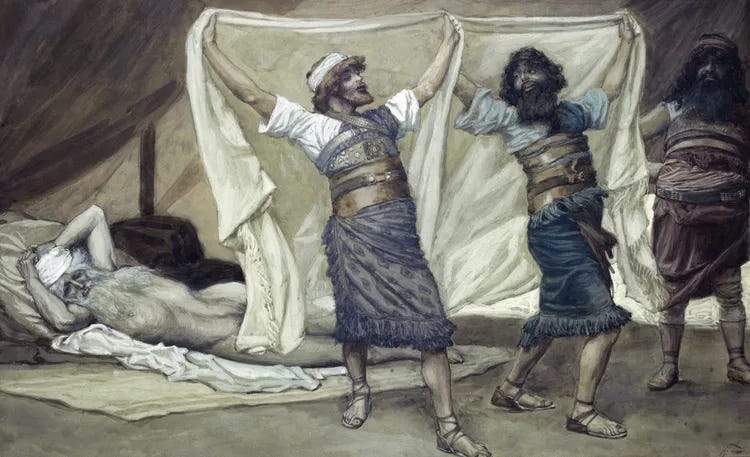
Since this is the first of my School Papers series, I thought I’d start if off spicy with Genesis 9. AKA what the heck happened with Noah getting drunk and Ham seeing him naked? Ya know, easy stuff. Keep in mind this was meant to be a very short paper, and so not every angle of the issue could be fully addressed. I’d love to hear your thoughts, questions, and pushbacks in the comments! What do you think is happening in Genesis 9?
Happy reading!
Introduction
Genesis is an aptly named text, with the word Genesis meaning “beginning.” In the Hebrew it is named Bĕrēʾšît.[1] Genesis 1-11 is especially concerned with beginnings, as it relates the creation and ordering of the cosmos, the institution of humanity as God’s image-bearing regents in the world, the fall, and the beginnings of God’s plan to set the project back on track through the family of Abraham (Genesis 11:27-32).
Authorship of Genesis, and the Pentateuch of which it is a part, cannot be answered with certainty. The text itself attests to Moses having written down certain events at the command of God (Exodus 17:14, Deuteronomy 31:9, 24). These verses led to the widespread assumption that Moses was the sole author of the Torah up until critical scholarship began questioning this – and not without reason.[2] For instance, if Moses was the sole writer, how could he have written the text after his death? (Deuteronomy 34:5-12). This points, at minimum, to some kind of later editor or redactor who added to whatever Mosaic core there might have been, if not a number of them. Yet, there are also details that point to early composition of certain parts of the narrative such as the influence from other primeval-cosmic stories in surrounding cultures, the etymology of certain names, the price Joseph’s brothers sell him into slavery for, and more.[3] These data points, along with such theories as the Documentary Hypothesis, also make exact dating of the text of Genesis quite difficult, with some scholars dating it as early as the time of the Exodus, with Moses drawing on the oral tradition of Israel in the fifteenth-thirteenth centuries BC, to as late as the return from exile in the time of Ezra and after, in the sixth and fifth centuries BC.
Outline
1. The Primeval Era (Genesis 1:1-11:32)
a. Creation and Ordering (1:1-2:25)
i. of the Cosmos (1:1-2:3)
ii. of Eden, Adam, and Eve (2:4-2:25)
b. Humanity’s Downward Spiral (3:1-11:32)
i. Fall and Exile (3:1-24)
ii. Cain and the Murder of Abel (4:1-16)
iii. Cain’s Violent Line (4:17-26)
iv. Adam to Noah (5:1-32)
c. De-Creation & New Creation (6:1-9:17)
i. De-Creation: The Flood (6:1-8:22)
ii. New Creation: God’s Covenant with Noah (9:1-17)
d. Humanity’s Continued Downward Spiral (9:18-11:32)
i. The Sons of Noah (9:18-29)
ii. The Table of Nations (10:1-32)
iii. De-Creation: The Tower of Babel (11:1-9)
iv. Anticipation of New Creation: Shem to Abram (11:10-32)
Exegetical Issue
One exegetical issue that looms large over readers of Genesis 1-11 is the episode of Noah’s drunkenness and the curse on Canaan found in 9:18-29. After Noah has been delivered through the waters of the flood, God makes a covenant with Noah and his family never to judge the world in this way again. As with Adam, God blesses Noah to be fruitful and multiply, giving him dominion over the world as His imagers. Thus, Noah begins to work the ground. Yet Noah takes the fruit of the land, becomes naked, and sins – an echo of the sin of the Garden – by way of drunkenness. Then, Noah’s son Ham “saw the nakedness of his father” (9:22). When Noah recovers from his drunken state and sees whatever Ham has done, he curses not Ham, but Ham’s son, Canaan. Literarily, this passage is intentionally hyper-linked to the sin of the Garden through the imagery of taking of fruit, nakedness, shame, and relational breakdown as a result of sin. Noah’s drunkenness and Ham’s sin illustrate that, though God has saved Noah’s family and reinstated them as his imagers with a covenant, humanity is still broken and outside of Eden. While these themes are clear, one large question still remains: what is it that Ham has done? What does it mean to see his father’s nakedness? Why is Canaan cursed instead of Ham?
The NIV Biblical Theology Study Bible (here on referred to as NIVSTB) acknowledges that this is a complex passage with various possible explanations.[4] The Ham must have done more than just see his father naked for there to be such a curse on Ham’s line through Canaan.[5] The NIVSTB does not offer explicit interpretations of what it is that Ham has done except to hint at some kind of sexual immorality between Noah and Ham that results in Canaan, hence his cursing. “If Canaan is the fruit of some sort of sexual immorality, Noah could have cursed this symbol of his shame. This also may anticipate the future role of the Canaanites under Joshua and under David and Solomon.”[6] The NIVSTB thus sees this episode as further explaining the brokenness and fragmentation of the human family and the state of the world, as this is one of the central themes of Genesis 1-11. This is a helpful way of situating the story in the larger canonical context, and certainly has merit, but it ultimately does not resolve the central questions of the story.
On the other hand, David Carr takes a different approach in his commentary. While he agrees with the NIVSTB in seeing this episode as a prophetic explanation of the idea of the Canaanite peoples being subject to Israel, as well as explaining the broken state of the world outside of Eden, Carr goes in a different direction. First, operating from a text-critical perspective, Carr postulates that Ham’s name was added by later scribes and redactors of the text, thus leading to the confusion between why Canaan is cursed for what Ham does.[7] This must be why, Carr reasons, when Noah pronounces a curse on Canaan, he refers to him serving his brothers, Japeth and Shem. Thus, having taken care of that question, he turns to the question of what exactly it is that Ham has done. While he considers the various interpretive options that have been offered, Carr rejects them outright. He says these readings see too much in the text that is not there. Instead, attention must be given to how Canaan’s/Ham’s brothers, Shem and Japeth, do not see Noah’s nakedness and treat their father with honor. Carr argues that
“…interpreting the misdeed of Noah’s son as incest goes well beyond the text’s own description of his misdeed…Rather, it seems better to take Gen 9:22 and 9:23 as examples of failed and successful examples of filial obligation of sons toward their (drunken) father. Ancient Near Eastern texts, including the Bible, put a high value on children’s honoring and caring for their parents, filial obligation, that has been missed by many interpreters.[8]
Yet, while this argument gives due respect to the Ancient Near Eastern context of honor for one’s parents as well as Ham’s brothers action in the story, it, too, does not fully answer every question in the text. For example, if Noah was naked of his own accord due to his drunkenness –how could he awake and recognize what Ham had done, here just seeing Noah’s nakedness? Carr himself notes this weakness in his view, stating that the text just does not give an answer.[9] Carr’s explanation provides clues to the answer, but does not full answer the questions of the story to satisfaction.
A better answer, that accounts for all of the clues in the text, is here given. The NIVSTB is correct in connecting the language of seeing the nakedness of Noah with sexual immorality. As Leviticus 18:7 says, “You shall not uncover the nakedness of your father, which is the nakedness of your mother” (English Standard Version). Notice that the Law equates the nakedness of the father with the nakedness of the mother. Another translation gets at the deeper meaning of the phrase: “Do not dishonor your father by having sexual relations with your mother.” (Lev. 18:7, New International Version). Thus, the language of seeing the nakedness of one’s father is equated with having sex with one’s mother.
This has great explanatory power for the questions in the text. First, Japeth and Shem honor their father in their actions, be it by not following in Ham’s incest or by looking on their parent’s literal naked bodies. Second, Canaan is cursed rather than Ham because he is the result of the shameful union of Ham with his own mother. Third, this explains how Noah could have understood what Ham had done upon waking. He would not have needed to understand that his wife was pregnant to grasp what Ham had done to her. Fourth, Ham’s motivations to shame his father may be clearer in this reading, as Carr emphasized. Ham explicitly shames his father by having sex with his mother and bragging about it to Shem and Japeth. Ham’s goal is to usurp his father’s position in Noah’s moment of weakness. A parallel elsewhere in Scripture is instructive here. When Absolam is working to steal the throne from his father, David, he engages in the same activity as Ham: in order to publicly shame David and elevate himself, Absolam sleeps with David’s wives and concubines “in the sight of all Israel” (2 Samuel 16:22, NIV). Like Absolam, Ham, seeing his father’s weakened state, seizes the opportunity to shame his father and make himself head of the household through sleeping with and impregnating his mother. Upon waking and realizing what has happened, Noah curses the offspring of Ham’s actions, Canaan. This answer resolves the difficult issues in the passage, noted by both Carr and the NIVSTB, while still emphasizing the same themes of explaining human brokenness outside of Eden and setting up the future conflict between Israel and the Canaanites.
Conclusion
Genesis 1-11 is a powerful, beautiful literary unit that accomplishes so much. It acts as a prologue to the entire biblical narrative, introducing the characters, conflicts, and setting that will go on to be explored and ultimately resolved by God’s saving, creative work in the world. Genesis 1-11 serves to explain the world as its audience knows it, whether it is being read in 580 BC, by Jews in the exile in Babylon, or 2025, by young seminary students in the digital age. Regardless of interpretive quandaries and head-scratching episodes, Genesis 1-11 reminds all who read it that humans exist outside of the Eden they were made for and that there is a powerful, loving, and present God who is working to restore what is broken.
Bibliography
Carson, D. A., gen. ed. T. D. Alexander, R. S. Hess, D. J. Moo, eds. NIV Biblical Theology Study Bible. Grand Rapids, MI: Zondervan, 2018.
Carr, David M. Genesis 1-11. International Exegetical Commentary on the Old Testament. Stuttgart, Germany: Kohlhammer, 2021.
Thanks for reading! What do you think - am I right? Or is there a better interpretation of Genesis 9 and Noah’s Drunkenness? Let me know in the comments! Subscribe to keep up with more School Papers coming soon!
[1] D. A. Carson, ed., NIV Biblical Theology Study Bible (Grand Rapids, MI: Zondervan, 2018), 17.
[2]David M. Carr, Genesis 1-11, International Exegetical Commentary on the Old Testament (Stuttgart, Germany: Kohlhammer, 2021), 51.
[3] D. A. Carson, ed., NIV Biblical Theology Study Bible (Grand Rapids, MI: Zondervan, 2018), 18.
[4] D. A. Carson, ed., NIV Biblical Theology Study Bible (Grand Rapids, MI: Zondervan, 2018), 40.
[5] Ibid., 40.
[6] Ibid., 40.
[7] David M. Carr, Genesis 1-11, International Exegetical Commentary on the Old Testament (Stuttgart, Germany: Kohlhammer, 2021), 281.
[8] Ibid., 284.
[9] Ibid., 284.
This is really helpful, thanks. It leaves me with only one question though: why does Noah know what his “youngest” son had done to him? In all the lists Japheth, not Ham, is the youngest.